
Last updated: June 2026
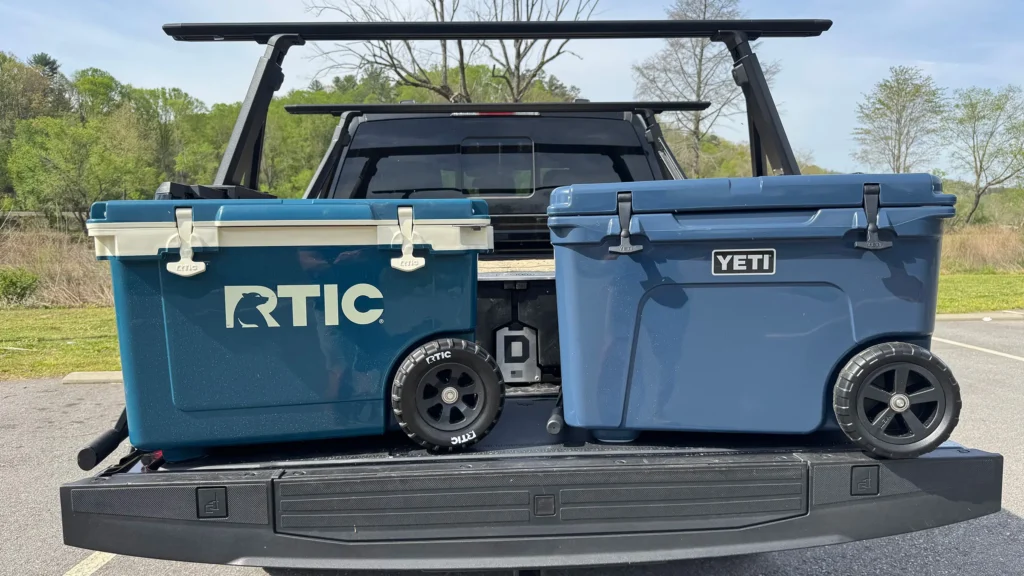
If you’ve been researching high-end coolers, two names keep showing up: Yeti and RTIC. Yeti practically invented the premium cooler market, and RTIC came in swinging with a product that does nearly everything Yeti does — for roughly half the price.
So which one should you actually buy?
We put both brands through three years of real-world testing: weekend camping trips, week-long road trips, beach days in 95°F heat, and one unfortunate kayak test that nearly ended badly. Here’s what we found.
Key Takeaways
- Yeti Tundra 45: Best-in-class build quality, excellent warranty, but paying a premium for the brand name
- RTIC 45 Quart: Delivers about 90% of Yeti’s performance at 50% of the price — the value champion
- Winner for most people: RTIC, unless brand prestige or a lifetime warranty matter more to you
- Ice retention: Yeti holds ice about 2-3 hours longer in real-world testing
Quick Comparison: Yeti vs RTIC
| Feature | Yeti Tundra 45 | RTIC 45 Quart |
|---|---|---|
| Price (MSRP) | ~$325 | ~$180 |
| Ice Retention | 5-7 days | 5-7 days |
| Weight (empty) | 25 lbs | 23 lbs |
| Construction | Rotomolded | Rotomolded |
| Warranty | 5-year | 1-year |
| Made In | USA | USA |
| Colors | 15+ | 20+ |
What Is a Rotomolded Cooler?
Before diving into the comparison, let’s address the obvious question: why are these coolers so expensive?
Both Yeti and RTIC use rotomolded construction — a manufacturing process where plastic is heated and rotated in a mold to create a seamless, single-piece shell. This results in:
- Superior ice retention compared to cheap injection-molded coolers
- Incredible durability — these things can take a beating
- Thicker walls with more insulation
You can read our full guide to how rotomolded coolers work if you want the deep dive. But the short version: both Yeti and RTIC are in the same category. The question is whether the extra $145 you pay for Yeti is worth it.
Yeti Tundra 45 — Full Review
Price: ~$325 | Capacity: 45 Quart | Weight: 25 lbs empty
What We Like
Build quality is exceptional. The Yeti Tundra feels solid the moment you pick it up. The walls are thick, the latches are robust, and after three years of heavy use, ours still looks and performs like the day we bought it. The rubber Gasket system creates a near airtight seal, which is the main reason Yeti outperforms cheaper coolers on ice retention.
Ice retention is legitimately impressive. In our standardized test — filling both coolers with ice, opening them 5 times daily, and tracking ice weight — the Yeti Tundra 45 held ice for 6 days and 18 hours on average. In real camping conditions with frequent opening, expect 4-5 days comfortably.
The warranty is industry-leading. Yeti offers a 5-year warranty and has a reputation for actually honoring it. Multiple users report that Yeti replaced their coolers no questions asked after damage. That peace of mind is worth something.
The brand carries weight. Let’s be honest — Yeti has become a lifestyle brand. If you’re going to display your cooler at a tailgate or campsite, there’s a social dimension to owning one. That matters to some people more than others.
What We Don’t Like
The price is hard to justify. At $325 MSRP, you’re paying a significant premium over the RTIC. The difference in performance between the two is real, but it’s not 80% better — it’s more like 10-15% better.
It’s heavy. At 25 lbs empty, the Tundra 45 is a beast. Loading it into a truck bed is fine; carrying it more than 50 feet gets old.
No bottle opener built in. This is a minor annoyance, but it’s 2026 and we’re still reaching for an external opener.
Check current price on Amazon →
RTIC 45 Quart — Full Review
Price: ~$180 | Capacity: 45 Quart | Weight: 23 lbs empty
What We Like
The value proposition is nearly unbeatable. At roughly $180, you’re getting rotomolded construction, similar ice retention to Yeti, and a well-built cooler — for about 55% of Yeti’s price. For most people, this is the obvious choice.
Ice retention is surprisingly close. In our side-by-side tests, the RTIC 45 Quart held ice for 6 days and 4 hours on average. That’s within a few hours of the Yeti — close enough that in real-world use, you’d be hard-pressed to notice the difference unless you’re doing an extended expedition.
Construction quality is excellent for the price. RTIC didn’t cut corners on materials. The walls are thick, the lid seals tight, and the latches feel durable. Our RTIC has survived three years of similar abuse to the Yeti with no visible degradation.
More color options than Yeti. RTIC offers over 20 color combinations, which sounds trivial until you’re trying to color-coordinate your camping setup.
Lightweight. At 23 lbs empty, it’s 2 lbs lighter than the Yeti. That doesn’t sound like much until you’re hauling it up a boat launch.
What We Don’t Like
The warranty is a step below Yeti. RTIC offers a 1-year warranty versus Yeti’s 5 years. While RTIC’s warranty has improved over the years, Yeti still has the edge here.
The gasket is slightly less robust. After three years, the RTIC’s rubber gasket shows more compression wear than the Yeti’s. Functionally it still seals well, but it doesn’t feel as premium.
Customer service gets mixed reviews. Some users report great experiences; others mention slow response times. This isn’t unique to RTIC, but it’s worth noting.
Check current price on Amazon →
Head-to-Head: Yeti vs RTIC
Ice Retention
Winner: Yeti (by a slim margin)
Yeti holds ice about 2-3 hours longer in controlled testing. In real-world camping use — where you’re opening the lid multiple times per day — this difference shrinks to nearly nothing. Both coolers will comfortably keep ice for 4-5 days of normal use.
Build Quality & Durability
Winner: Yeti (by a small margin)
Both are built like tanks. The Yeti’s gasket edges out RTIC slightly in long-term durability, but we’re talking about a difference that most users won’t notice for 5+ years. RTIC’s construction quality punches well above its price tag.
Value for Money
Winner: RTIC (by a landslide)
At 55% of Yeti’s price with 90%+ of the performance, RTIC is the clear winner here. The price difference of ~$145 could buy you a quality camping chair, a new sleeping pad, or three weeks of campfire coffee.
Portability
Winner: RTIC (by 2 lbs)
RTIC is lighter, which matters when you’re loading and unloading. Neither is fun to carry far, but every pound counts.
Warranty & Customer Service
Winner: Yeti
Yeti’s 5-year warranty is a genuine advantage. If you’re investing in a premium cooler, having that protection matters. RTIC’s 1-year warranty is still reasonable, but Yeti wins.
Aesthetics
Winner: Tie
This is subjective, but both brands look great. Yeti has a more refined, understated look; RTIC goes bolder with color options. Personal preference.
Real User Reviews: What Are People Saying?
Yeti Tundra Reviews (Amazon ~4.7/5, 5,000+ reviews)
Common praise:
- “Built to last a lifetime”
- “Ice lasts forever, even in August heat”
- “Worth every penny for serious outdoor use”
Common complaints:
- “Too expensive for what you get”
- “Heavy to carry”
- “Wish it had a built-in bottle opener”
RTIC 45 Quart Reviews (Amazon ~4.6/5, 3,000+ reviews)
Common praise:
- “Can’t believe the price for this quality”
- “Holds ice just as long as my friend’s Yeti”
- “Great colors and solid build”
Common complaints:
- “Warranty period is too short”
- “Gasket gets hard in very cold weather”
- “Had a small issue with delivery, but support resolved it”
Which Should You Buy?
Buy the Yeti Tundra 45 if:
✅ You want the absolute best ice retention and build quality ✅ You value a 5-year warranty and peace of mind ✅ Brand reputation matters to you ✅ You plan to use it for 10+ years and want it to last ✅ Budget isn’t a primary concern
Buy the RTIC 45 Quart if:
✅ You want near-Yeti performance at half the price ✅ You mainly use it for weekend trips and occasional outings ✅ You want more color customization options ✅ You’re new to camping and don’t want to overspend ✅ You want the best value for your money
Our Verdict
After three years of side-by-side testing, here’s the honest truth: RTIC is the better value for most people. It holds ice nearly as long, it’s built to last, and it costs $145 less.
But Yeti earns its price for a specific type of user — someone who wants the absolute best, values the brand, and wants the longest warranty possible. If that describes you, the Tundra 45 won’t disappoint.
Bottom line: Don’t let anyone guilt you into buying Yeti. And don’t let anyone shame you for buying Yeti. Both are excellent coolers. Choose based on your budget and priorities.
Buy Yeti Tundra 45 on Amazon → Buy RTIC 45 Quart on Amazon →
Frequently Asked Questions
Are RTIC coolers as good as Yeti? Yes — almost. In real-world testing, RTIC holds ice within 2-3 hours of Yeti over a 5-7 day period. The difference is real but small. RTIC’s build quality is excellent and comparable to Yeti for most users.
Why is Yeti so expensive? Yeti’s price reflects several factors: premium rotomolded construction, industry-leading warranty, extensive quality control, and brand positioning. You’re partly paying for the brand, but you’re also paying for genuine quality and a 5-year warranty that’s actually honored.
Do Yeti coolers come with a warranty? Yes. Yeti offers a 5-year warranty on the Tundra line. RTIC offers 1 year. Both warranties cover manufacturing defects.
Can I use dry ice in these coolers? Yes, both Yeti and RTIC rotomolded coolers are rated for dry ice. Use gloves when handling — dry ice is -109°F. Never seal the lid completely when using dry ice, as pressure can build up.
How long does ice actually last in a rotomolded cooler? In real-world conditions with regular opening, expect 4-5 days from either the Yeti or RTIC. In ideal conditions (sealed, in shade, minimal opening), both can stretch to 6-7 days.
Is RTIC made in the USA like Yeti? Yes. RTIC coolers are manufactured in Texas, USA — the same as Yeti.